

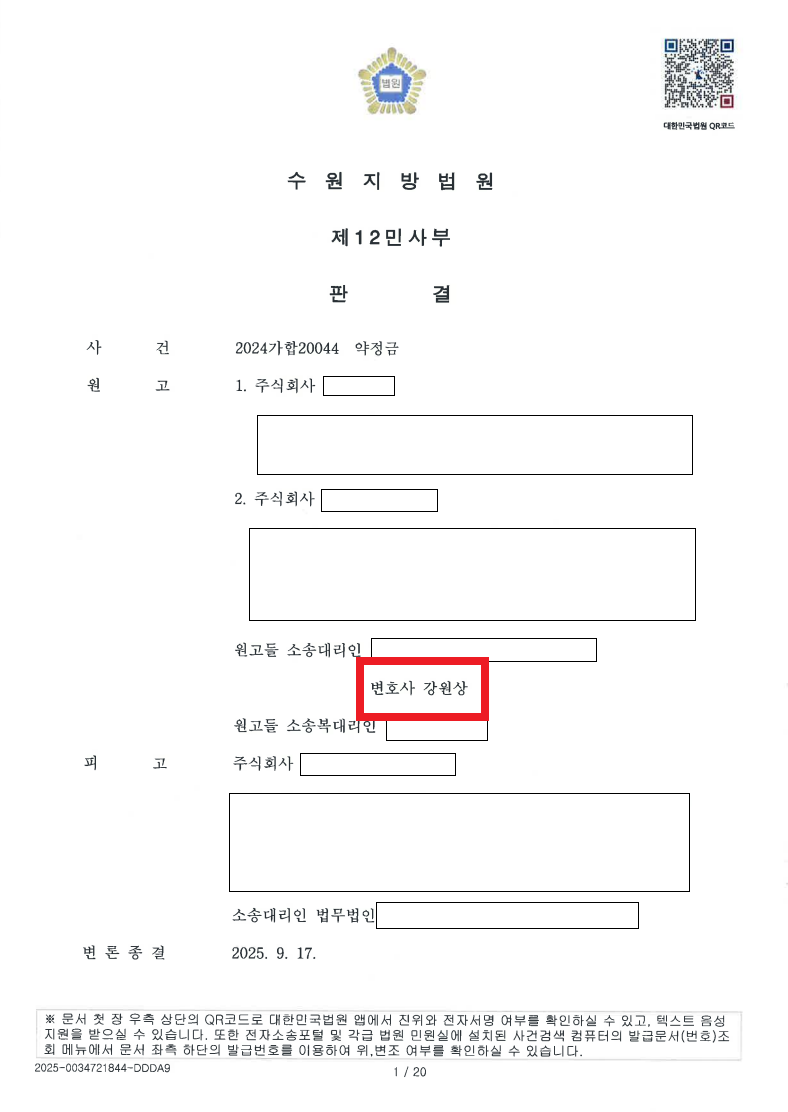
In a recent contract payment dispute in Korea, Kang & Shin secured a favorable judgment for a sales agency concerning a substantial “move-in support fee” that was structured as a promotional benefit ultimately intended to be passed through to unit purchasers. The defendant sought to avoid payment by asserting (i) an alleged but unwritten “tenant move-in” condition, (ii) invalidity of the claim assignment, and (iii) an unlawful “litigation trust” purportedly created solely to file suit. We addressed each defense in detail, and the court agreed with our position, ordering the defendant to pay KRW 946,000,000 plus statutory interest.
Case Snapshot
Parties and claim amount
- Plaintiff: Sales agency and related entities (our client)
- Defendant: Project company / counterparty
- Claim: KRW 946,000,000 plus delay damages (statutory interest)
Core issue
Kang & Shin represented the plaintiff in a contract payment dispute arising from a written agreement that required payment of a move-in support fee upon completion of the balance payments for all units. After that condition was satisfied, the defendant refused to pay, contending that the relevant provision was ambiguous and should be construed to require that certain designated tenants had moved in.
Our Position: Why the Defendant Had to Pay
A. The payment condition was satisfied
By the relevant date, the designated units were fully sold, balance payments were completed, and ownership transfers were processed. Under the language of the agreement, the payment obligation was triggered.
B. “Move-in completed” was never a contractual condition
The defendant’s refusal was based on: “clinics haven’t moved in yet, so we don’t pay.” Our position was straightforward: a court cannot add an unwritten condition to a written payment clause.
C. The claim assignment was valid and commercially reasonable
The sales agency later assigned the move-in support fee claim to the plaintiffs, who were themselves purchasers and were selected to pursue collection on behalf of the broader purchaser group. We emphasized the business rationale: efficient collection and distribution.
The Defendant’s Main Defenses
A. “This is an illegal litigation trust, thus the case must be dismissed”
The defendant argued the claim assignment existed only to file suit, violating the prohibition on litigation trusts, and therefore the case should be dismissed for lack of standing.
B. “Assignment was prohibited , and we didn’t consent”
The defendant also argued there was an assignment restriction requiring approval, and that it had opposed payment even before the assignment.
C. “No duty to pay until tenant move-in”
The defendant insisted the economic purpose of the fee was “tenant attraction,” so payment must be conditioned on actual tenant occupancy.
D. “We terminated the underlying agreement, so the claim disappeared”
The defendant argued it terminated the relevant agreements later, and that this extinguished any assigned claim.
The Court’s Decision: Plaintiffs Win
A. The court rejected the “litigation trust” argument
The court found the assignment was not a sham designed only to bypass attorney representation rules. It viewed the move-in support fee as substantively connected to the purchasers and accepted that the assignment structure was used to streamline collection.
B. No “move-in completed” condition existed in the operative payment clause
The court focused on the written terms: the trigger was balance-payment completion, and the agreement did not impose an additional tenant-occupancy condition.
C. Assignment defenses did not defeat payment
The court did not accept the defendant’s arguments that the claim assignment was invalid or ineffective against the defendant under the circumstances presented.
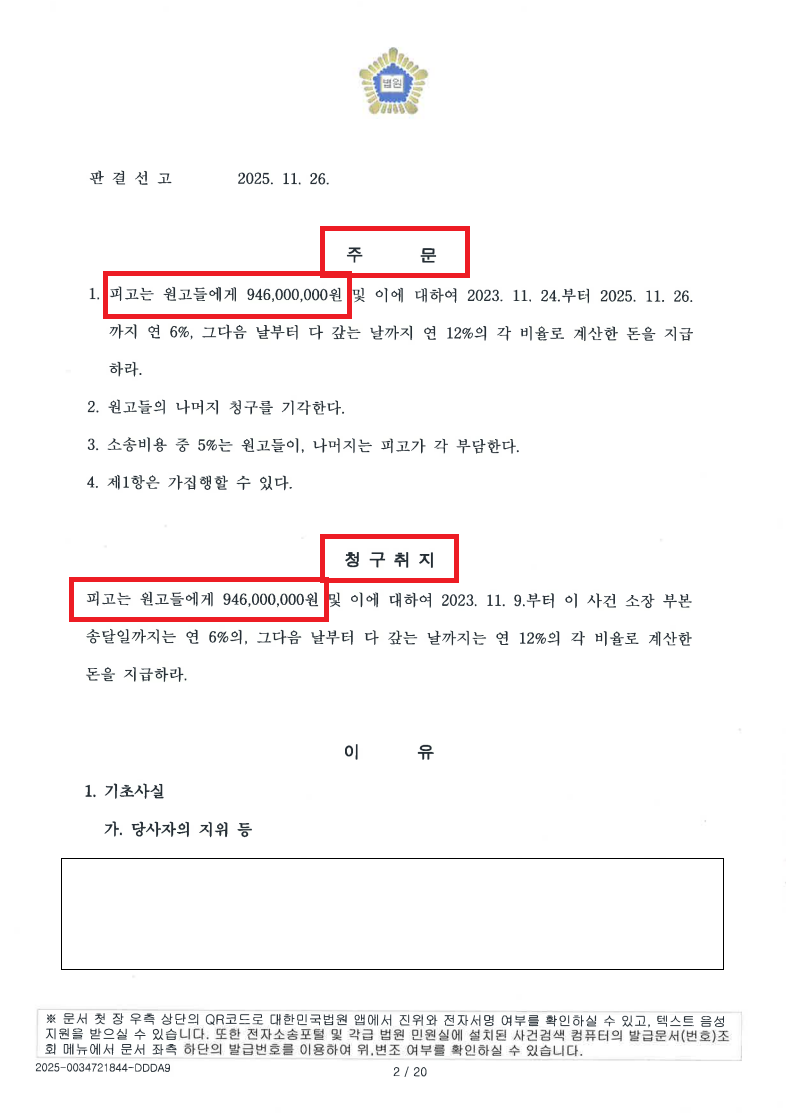
D. Result: KRW 946,000,000 plus interest
The judgment ordered the defendant to pay:
- KRW 946,000,000, and
- Interest at 6% per annum for a specified past period, and 12% per annum thereafter until full payment (statutory post-judgment interest), with provisional enforceability recognized.
Why This Case Matters for Disputes in Korea
A. Written contract language controls. Courts resist “after-the-fact conditions”
If the agreement clearly states when payment is due, a party cannot retroactively insert conditions like “only if tenants move in” unless the contract actually says so.
B. Claim assignments can be effective, but structure and purpose matter
When purchasers are the real economic stakeholders, and the assignment is used to simplify collection, courts may reject arguments that it is an illegal litigation trust.
C. Developers and counterparties should treat “promotion funds” carefully
If a fund is designed to drive sales and is promised in writing, refusal after sales complete can trigger significant exposure, including statutory interest.
Why Choose Kang & Shin for Litigation?
This case demonstrates that even against large developers with sophisticated legal teams, property owners and businesses can win when they have the right legal strategy. Whether you are dealing with a contract dispute, real estate issues, or complex matters, having a Korean lawyer for foreigners ensures that your rights are defended with precision. At Kang & Shin, we build strategies that win.
