

Administrative Litigation Victory in Korea often becomes essential when a government office refuses to accept a legitimate application or report without a legally sufficient basis. In a recent landmark case, Kang & Shin successfully represented a plaintiff in an administrative lawsuit challenging a local government office’s refusal to accept a resident registration move-in report.
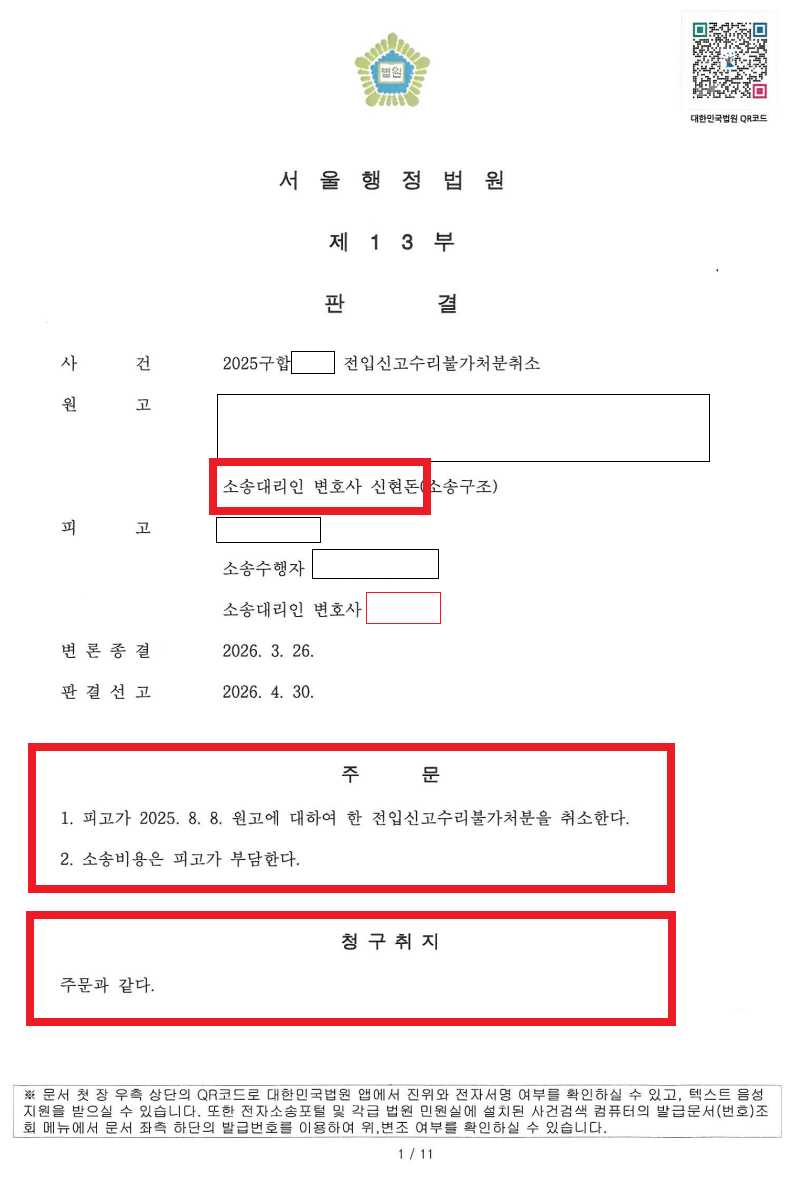
The Seoul Administrative Court ruled in favor of our client, canceled the refusal disposition, and ordered the defendant to bear the litigation costs. This was a complete victory for the plaintiff.
Background of the Case
The case involved a resident registration move-in report for a building located in a redevelopment-related area in Seoul. The plaintiff filed a move-in report with the relevant local government office, stating that he had moved from his previous registered address to the building where he was actually living.
However, the local government office refused to accept the report. The stated reason was that the area had been designated as an urban development zone and was subject to a development plan. In other words, the government office treated the redevelopment status of the area as a reason to reject the resident registration report.
Kang & Shin challenged that decision by filing an administrative lawsuit seeking cancellation of the refusal disposition.
The Key Legal Issue
The central issue was whether the government office could refuse to accept a resident registration move-in report simply because the building was located in an urban development or redevelopment-related area.
Our Argument: the resident registration system is meant to reflect a person’s actual residence. If a person is actually living at a certain place and intends to reside there for at least 30 days, the government office should not refuse the report based on reasons unrelated to the statutory requirements of resident registration.
The court agreed.
The Court’s Reasoning
The court focused on the purpose of the resident registration system. Under Korean law, resident registration is designed to identify and record the actual residence of residents so that administrative affairs can be handled properly.
The court examined the evidence and found that the plaintiff had a real residential connection to the building. The court considered various facts, including the condition of the building, the presence of living facilities, the plaintiff’s actual use of the space, statements from people familiar with the plaintiff’s residence, and the circumstances surrounding the plaintiff’s daily life.
The court concluded that the plaintiff had filed the move-in report for the purpose of making his resident registration consistent with his actual living situation.
The Government’s Development-Zone Argument Was Rejected
One of the most important points in this case was that the government office relied on the redevelopment status of the area as the basis for refusal.
The court rejected that approach. It held that the local government office could not refuse to accept the move-in report simply by saying that the area had been designated as an urban development zone or was subject to a development plan.
In other words, the administrative authority’s review should focus on whether the requirements for resident registration are met. It should not use the resident registration process as a broader tool to control redevelopment issues or other policy concerns unrelated to the statutory requirements.
Complete Victory for the Plaintiff
The Seoul Administrative Court canceled the refusal disposition. The court also ordered the defendant to bear the litigation costs.
This result was significant because it restored the plaintiff’s ability to have his actual residence properly reflected in the resident registration system. It also confirmed that administrative agencies cannot reject a move-in report based on broad redevelopment-related concerns when the statutory requirements for resident registration are otherwise satisfied.
Why This Case Matters
This case is important for anyone dealing with administrative litigation in Korea.
First, it shows that a government office’s decision is not always legally correct. If an administrative agency refuses an application or report without a sufficient legal basis, that decision may be challenged in court.
Second, it shows that administrative litigation often turns on identifying the correct legal standard. The key question is not simply how the government office explains its decision, but whether that decision is supported by the applicable law, the relevant facts, and a sound legal analysis.
Third, it highlights the importance of evidence. In this case, the court carefully reviewed the factual circumstances showing actual residence. That type of evidence can be critical in lawsuits.
Administrative Litigation in Korea Requires Careful Strategy
Administrative lawsuits are different from ordinary civil disputes. They often require the court to review whether a government office acted within the limits of its legal authority.
A strong administrative litigation strategy should identify:
- the exact legal basis for the government’s decision;
- the statutory requirements that actually apply;
- whether the government considered irrelevant factors;
- whether the facts satisfy the legal standard; and
- what evidence best proves the client’s position.
In this case, the key was to show that the government office had focused on the wrong issue. The redevelopment status of the area did not justify refusing the resident registration report when the plaintiff had actually been living at the address.
Final Thoughts
This case was a successful administrative litigation victory in Korea. Kang & Shin challenged the government office’s refusal disposition, and the Seoul Administrative Court canceled the decision in full.
For individuals and businesses facing administrative disputes in Korea, early legal review can make a major difference. A refusal from a government office does not always mean the end of the matter. If the decision lacks a proper legal basis, it may be possible to challenge it through administrative litigation.
If you are dealing with a legal issue in Korea or need guidance from an English speaking lawyer in Korea, our firm can help you assess the legal issues and develop a strategy. To discuss your case, you can contact our office.
