
Detention Warrant Denied in Korea for Weapon Possession: In this recent case, Kang & Shin successfully opposed the prosecution’s request for detention, allowing the client to remain out of custody while the investigation continued. Because a detention warrant hearing usually takes place shortly after the prosecution requests a warrant, the defense must quickly identify the alleged grounds for detention and present concrete reasons why custody is unnecessary.
Case Background
The client was accused of carrying a knife through common areas of an apartment complex accessible to residents and members of the public. The investigative authorities alleged that the conduct caused fear or anxiety and relied on CCTV footage, witness statements, the seized knife, and the surrounding circumstances when requesting detention.
The prosecution argued that detention was necessary because of the seriousness of the alleged conduct, the possibility of reoffending, possible interference with witnesses, the risk of evidence destruction; and the risk of flight.
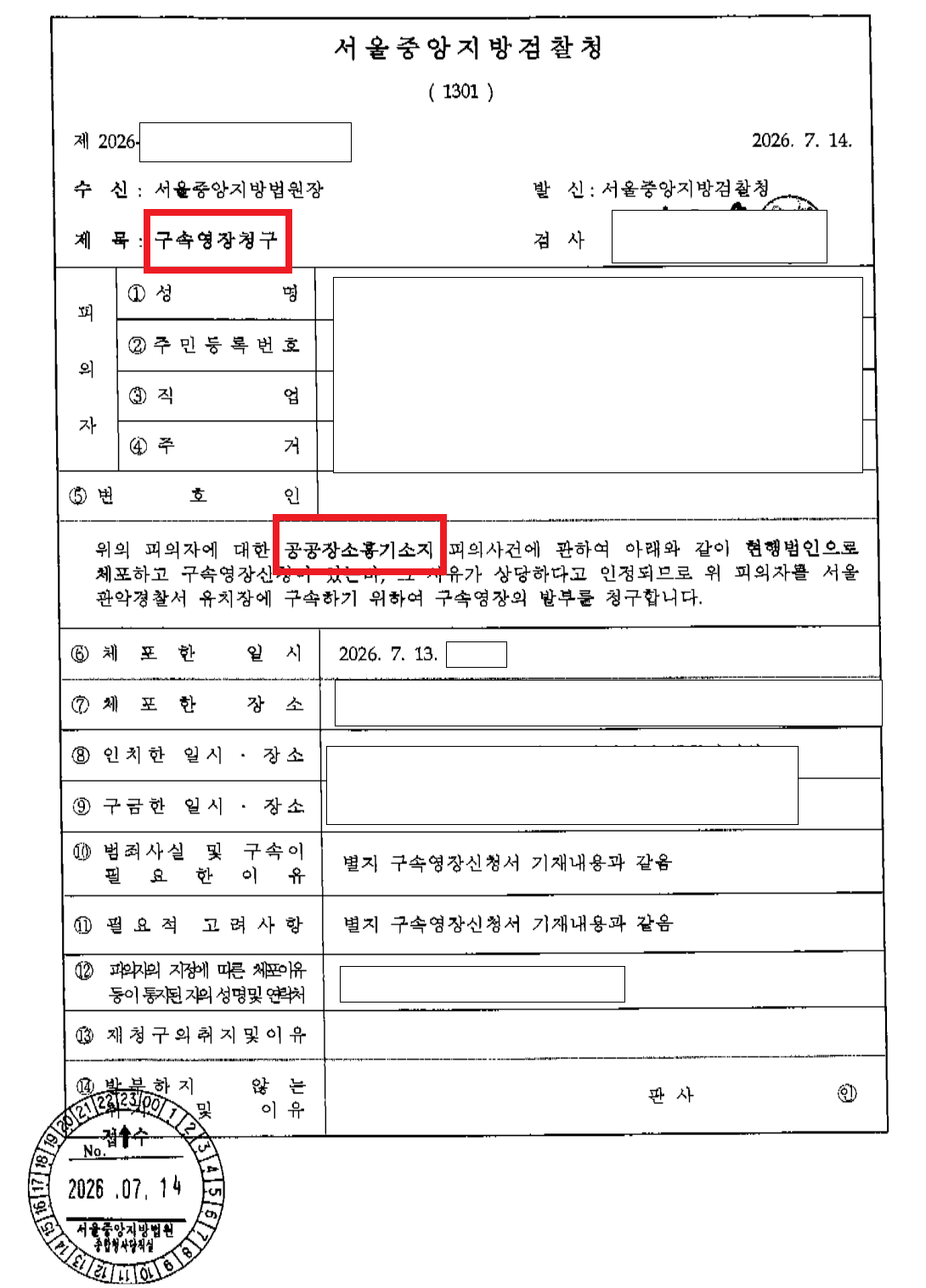
The prosecution requested a detention warrant in connection with the public-place weapon possession allegation. Personal and case-identifying information has been redacted.
Grounds for Detention in Korea
A serious allegation alone, however, does not automatically justify detention. The court must separately determine whether the statutory grounds for detention exist in the individual case.
When deciding whether to issue a detention warrant, a Korean court principally considers whether:
- the suspect has no fixed residence;
- there is a risk of evidence destruction; or
- there is a risk of flight.
The court also considers the seriousness of the alleged offense, the risk of reoffending, and the possibility of harm to victims or important witnesses.
Kang & Shin’s Defense
Attorney Won Sang Kang focused on the statutory grounds for detention and the client’s individual circumstances. The client had a fixed residence, intended to cooperate with the investigation, and agreed to appear whenever requested by the police, prosecution, or court. The knife, CCTV footage, witness statements, and other principal evidence had already been secured, leaving little to no opportunity for evidence destruction.
There was no specific evidence that the client intended to threaten, pressure, or influence witnesses. The client was also prepared to avoid contact with relevant individuals during the investigation.
Finally, the we emphasized that the seriousness of the allegation did not automatically justify detention. Considering the client’s residence, background, family circumstances, prior history, and willingness to cooperate, we requested that the investigation proceed without detention.
Case Result: Detention Warrant Denied
After reviewing the warrant application and hearing the defense, the Seoul Central District Court denied the detention warrant. This was a win for the client and Kang & Shin, as the prosecution’s request to detain the client was denied. The client was released and permitted to continue his daily life while fully exercising his right to prepare and present his defense.
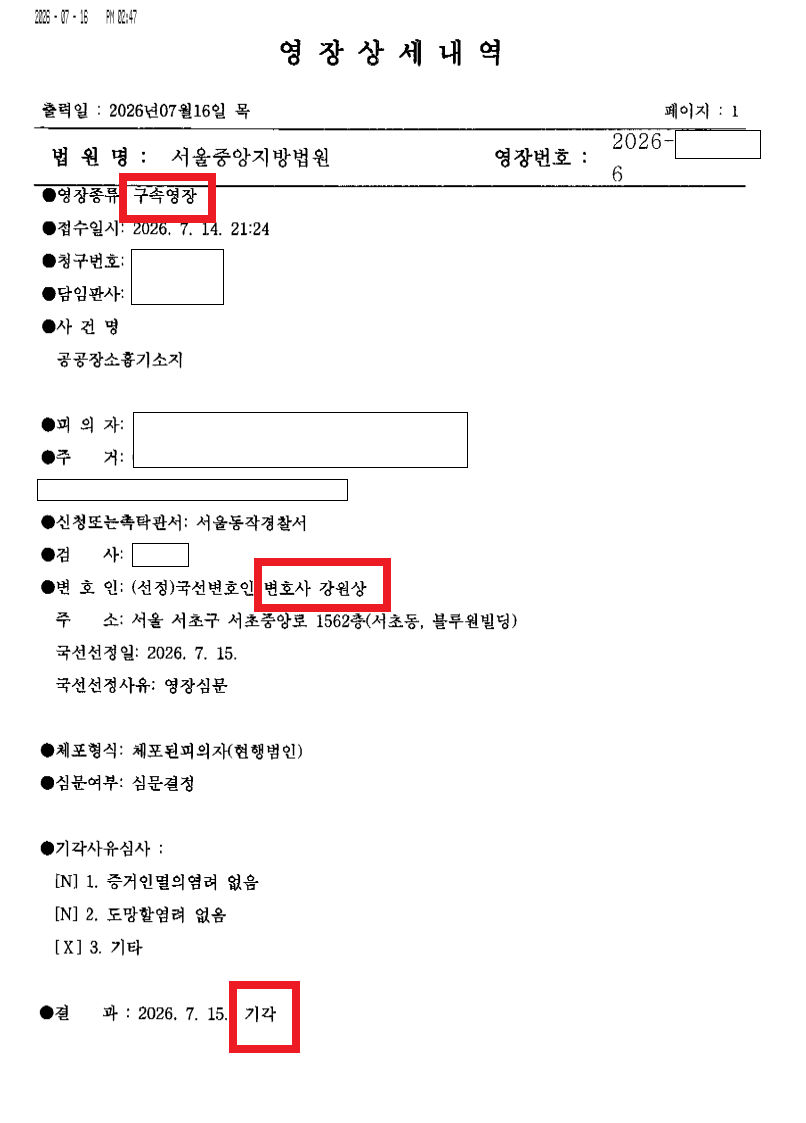
The Seoul Central District Court denied the detention warrant in the public-place weapon possession case represented by Attorney Won Sang Kang. Personal and case-identifying information has been redacted.
Does Warrant Denial End the Criminal Case?
The denial of a detention warrant does not constitute an acquittal or terminate the investigation. It means only that the court did not authorize continued detention at that stage. The police and prosecution may continue the investigation, and the prosecution may later decide whether to indict the suspect.
Nevertheless, remaining out of custody allows the client to communicate more effectively with counsel, collect and organize evidence, maintain family and personal responsibilities, and prepare and present the defense as effectively as possible.
Preparing for a Detention Warrant Hearing
The time available before a detention warrant hearing is limited. Counsel will need to review the warrant application, interview the client, prepare a written opinion, and present oral arguments within a short period.
Relevant supporting materials may include proof of a fixed residence, employment and family records, evidence of prior cooperation with investigators, proof that physical and electronic evidence has already been secured, non-contact commitments; and materials addressing the alleged risk of reoffending.
An experienced criminal defense lawyer will connect each favorable fact to a specific detention issue rather than relying solely on general assurances that the client will cooperate.
Facing a Detention Warrant During a Criminal Investigation in Korea
A detention warrant request can arise suddenly during a criminal investigation and requires immediate and focused preparation. The defense should directly address the prosecution’s allegations concerning flight, evidence destruction, reoffending, and possible interference with witnesses.
For foreign nationals, language barriers and unfamiliarity with Korean criminal procedure can make it especially difficult to respond within the limited time available. Kang & Shin represents foreigners in police investigations, prosecution proceedings, detention warrant hearings, and criminal trials.
Learn more about working with an English-speaking criminal defense lawyer in Korea.
For broader bilingual legal assistance, visit our homepage to learn more about working with an English-speaking lawyer in Korea.
