
Kang & Shin successfully represented a foreign service member in a special intimidation case dismissed in Korea at the police investigation stage. The case arose from allegations of retaliatory driving.
The police alleged that the client had blocked another driver’s path, attempted to direct the vehicle toward the shoulder, and braked suddenly in front of it. These allegations led to a criminal investigation for special intimidation. Our attorney attended the police interview, analyzed the investigator’s questions, and carefully reviewed the dashcam footage presented during the investigation. Kang & Shin then submitted a detailed written defense explaining why the client’s actions did not constitute a criminal threat and why he lacked any intention to intimidate the other driver.
Following our written submission, the police dismissed the case at the investigation stage by issuing a no-referral decision for insufficient evidence.
Background of the Investigation
The client received a formal request to appear at a Korean police station as a suspect in a special intimidation case.
According to the initial allegation, the client had driven in front of another vehicle, slowed down, moved toward the shoulder, and later applied the brakes while the other vehicle was behind him.
Because a motor vehicle may be treated as a dangerous object when deliberately used to threaten another person, the incident was investigated as special intimidation (특수협박).
For a broader explanation of the law, possible penalties, license consequences, and common defense strategies, see our guide: Retaliatory Driving in Korea: Police Investigation, Penalties, and Defense Strategy.
This case depended on a different question: did the complete dashcam recording actually prove that the client had intentionally used his vehicle to frighten the other driver, as special intimidation requires intent?
Careful Review of the Police Interview and Dashcam Footage
Kang & Shin attended the client’s police interview from the beginning.
During questioning, our attorney closely followed the investigator’s questions to understand the theory of the case. The investigator focused on the client’s gestures, movement toward the shoulder, braking, and subsequent driving conduct.
The investigator also showed the reporting driver’s dashcam footage. Rather than viewing one braking event in isolation, our attorney reconstructed the full sequence of events. This revealed several facts supporting the client’s position of having no intent.
Kang & Shin’s Written Defense
The written defense addressed both essential parts of the alleged offense:
Actus Reus: No Threat
The client’s conduct, viewed in context, did not amount to a communication of harm sufficient to constitute intimidation.
The client’s inviting the other vehicle to pass, use of hazard lights, and movement toward the shoulder were inconsistent with an attempt to trap or threaten the reporting driver.
Mens Rea: No Intent
Furthermore, the defense established that the client lacked the requisite criminal intent. Through a meticulous analysis of the facts, we logically demonstrated the absence of mens rea. Kang & Shin argued that each disputed action had a reasonable alternative explanation, emphasizing that maneuvers such as braking or following another vehicle cannot automatically be construed as retaliatory driving. Instead, the complete sequence of events must be evaluated in context.
Result: Case Dismissed at the Police Stage
After reviewing Kang & Shin’s comprehensive written defense, the police issued a formal non-referral decision citing insufficient evidence. Consequently, the special intimidation case was successfully dismissed at the police stage and was not forwarded to the prosecution—securing the most favorable outcome possible.
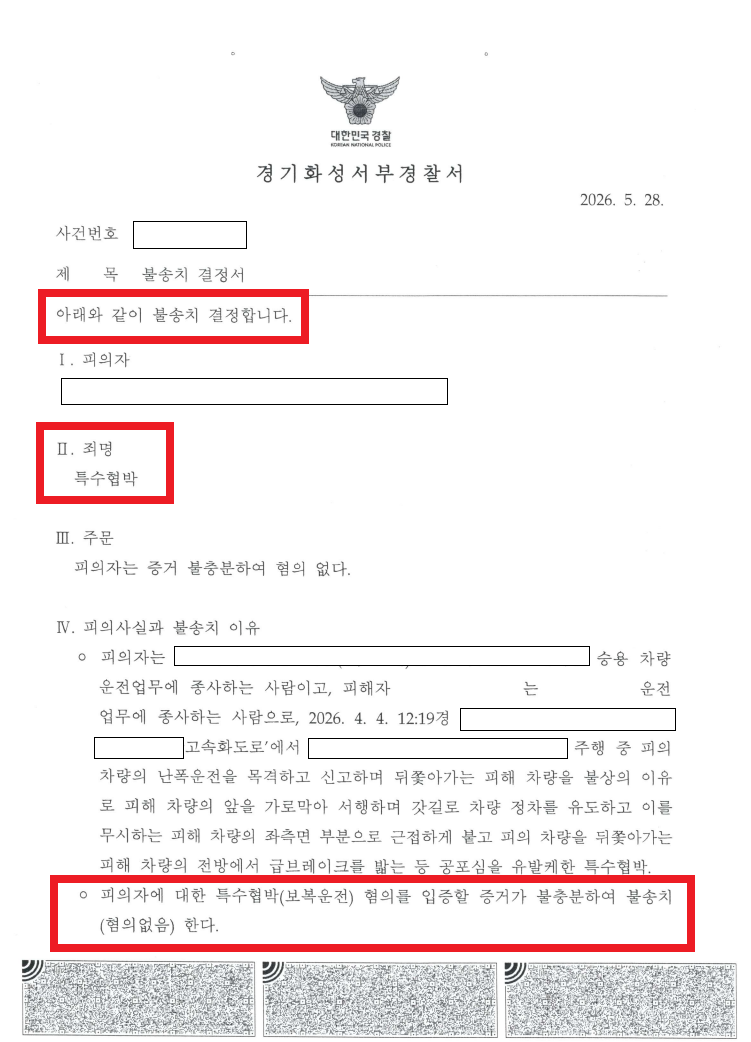
The police issued a no-referral decision for insufficient evidence in the special intimidation case handled by Kang & Shin.
This decisive result allowed the client to completely avoid prolonged prosecutorial investigations and the burden of a criminal trial.
Why Early Criminal Defense Matters
An effective defense should examine:
- what happened before the disputed conduct;
- which vehicle first reduced the distance;
- lane changes and acceleration;
- hazard lights and other signals;
- gestures exchanged between the drivers; and
- whether the accused driver acted deliberately or instinctively.
The first police interview can also shape how the investigator understands the entire case. Early assistance from a criminal defense lawyer in Korea will be particularly important when the case depends on video evidence and disputed intent.
Criminal Defense for Foreign Clients in Korea
Foreign suspects may face additional difficulty because of language barriers and unfamiliar Korean procedures. Kang & Shin provides criminal defense services in English and Korean. Our attorneys prepare clients for questioning, attend police and prosecution interviews, review evidence, communicate with investigators, and submit written defense opinions in Korean.
Foreign clients seeking an English-speaking lawyer in Korea may contact Kang & Shin to discuss a criminal investigation. You may also visit our Professionals page to learn more about our attorneys’ qualifications and experience.
