
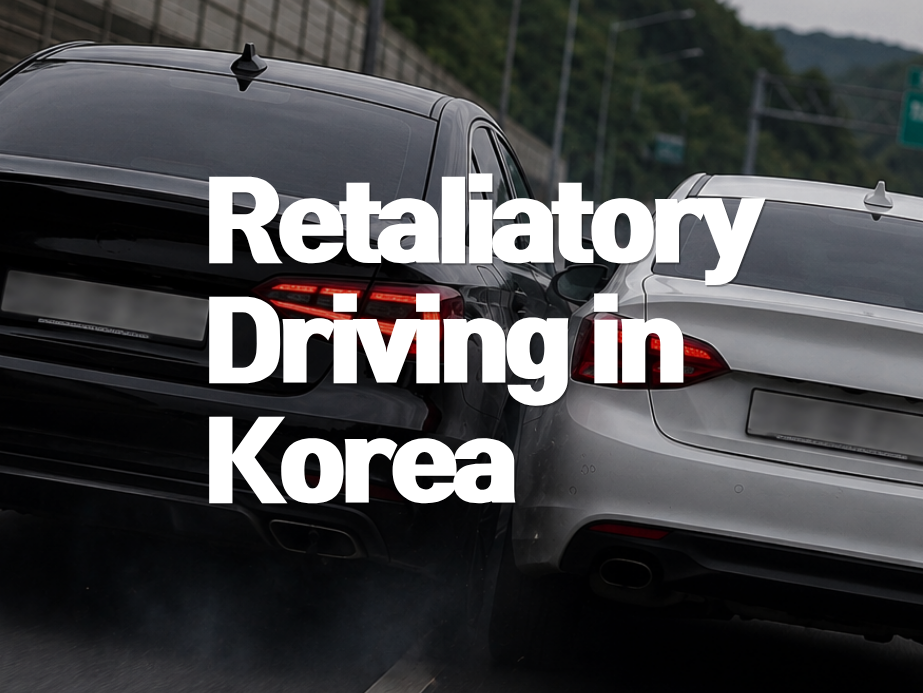
A road dispute in Korea can quickly become a criminal matter. Sudden braking, aggressive lane changes, repeated honking, or following another vehicle may look like a momentary emotional reaction, but if the conduct is directed at a specific driver, it may be treated as retaliatory driving in Korea (보복운전). For foreigners living in Korea, this can be especially confusing. What may seem like a traffic argument can lead to police questioning, criminal charges, settlement issues, and even driver’s license suspension.
This article explains the difference between reckless driving and retaliatory driving in Korea, what evidence matters, and how to prepare if you are called in for police questioning.
Reckless Driving
Reckless driving occurs when a driver’s actions create a general danger on the road through repeated traffic violations.
- Key element: It requires repetition.
- Examples: Repeatedly running red lights, sudden lane changes, sudden braking, or continuous honking.
- Honking once or making a single sudden lane change may result in a traffic fine, but it does not constitute reckless driving on its own.
Retaliatory Driving
Retaliatory driving occurs when a driver intentionally threatens a specific driver using their vehicle.
- Key element: It does not need to be repeated; a single intentional act of threatening another driver is enough to face criminal charges.
- Examples: Suddenly braking in front of someone, chasing a car while honking, blocking another car’s path, or pushing a car toward the center line or shoulder.
The Severe Penalties for Retaliatory Driving
Because retaliatory driving involves targeting a specific individual, it is treated much more harshly than reckless driving. Under the Korean Criminal Act, a vehicle may be treated as a “dangerous object.” Using a vehicle to threaten or harm someone elevates the crime significantly.
- Criminal Charges: You can be charged with special intimidation, special assault, special injury, or special property damage.
- No Automatic Dropping of Charges: Unlike simple assault or simple intimidation, these “special” crimes are not offenses where charges are automatically dropped just because you reach a settlement with the victim. Even if you settle, the police investigation and trial may continue.
- Administrative Penalties: If booked for retaliatory driving, you can receive 100 penalty points, leading to a driver’s license suspension. If you are arrested, your license can be canceled. Furthermore, receiving a suspension of indictment does not automatically cancel these administrative license penalties.
How to Defend Against Retaliatory Driving Accusations
Because anyone can be falsely accused of retaliatory driving after a sudden stop or lane change, knowing how to defend yourself is critical.
1. Disproving “Intent”
To be convicted of retaliatory driving, there must be a deliberate intent to take revenge or threaten the other driver. Simple driving errors, sudden braking due to road conditions, or traffic accidents caused by negligence do not constitute retaliatory driving. Your defense should focus on proving that your actions were defensive, due to a lack of driving skill, or an attempt to avoid a sudden hazard.
2. The Importance of Dashcams (Black Boxes)
The most crucial piece of evidence is your dashcam video.
- Audio is vital: Dashcams often record cabin audio. If the audio captures you swearing or saying things like “Let’s see how you like this,” the police will likely assume you had malicious intent. However, if the audio records you gasping in surprise or talking normally with a passenger, it strongly supports the argument that it was a sudden accident without retaliatory intent.
- Act quickly: Dashcam footage overwrites itself quickly, and CCTV footage is only kept for a short time. Secure your video immediately after an incident.
3. How to Prepare for Police Questioning
How you speak during your first police investigation dictates the direction of the entire case.
- What NOT to say: Do not say, “They made me mad first,” or “They cut me off, so I followed them.” This is an admission of emotional retaliation and intent.
- What to say: Explain the objective road conditions. Detail why you had to brake suddenly or change lanes to avoid danger, backing up your claims with dashcam footage, CCTV, and road structure data.
Note: If the evidence against you is overwhelmingly clear, blindly denying the charges can harm your case. In such situations, admitting fault, showing remorse, and actively seeking a settlement with the victim is the most realistic way to pursue leniency, such as a suspension of indictment.
Final Thoughts: Don’t React on the Road
If you are under investigation for retaliatory driving or another driving-related criminal offense, speaking with a criminal lawyer in Korea early in the process is essential to ensure the best outcome. For broader legal guidance or to protect your rights in a complex dispute, consulting an English speaking lawyer in Korea will give you the strategic advantage you need. Contact our office today to discuss your case and build a strong defense.
